how to implement AI in business
How to Implement AI in Business: A 30-Day Pilot Plan
A 30-day plan to prepare your team, choose one process, set data rules, run a small pilot, and decide whether it is worth continuing.
Contents
How should a company implement AI in business during the first 30 days? Do not try to “roll out AI across the company.” A more useful target is to select one measurable business process, name the owners, set rules, train the pilot team, review data and permissions, and gather enough evidence from a bounded pilot to decide whether to proceed, revise, or stop.
Thirty days is not a promise of production transformation, regulatory compliance, or return on investment. Complex processes, sensitive data, and difficult integrations may require longer preparation. A sound day-30 outcome can also be a documented decision that AI is not the right tool for this process.
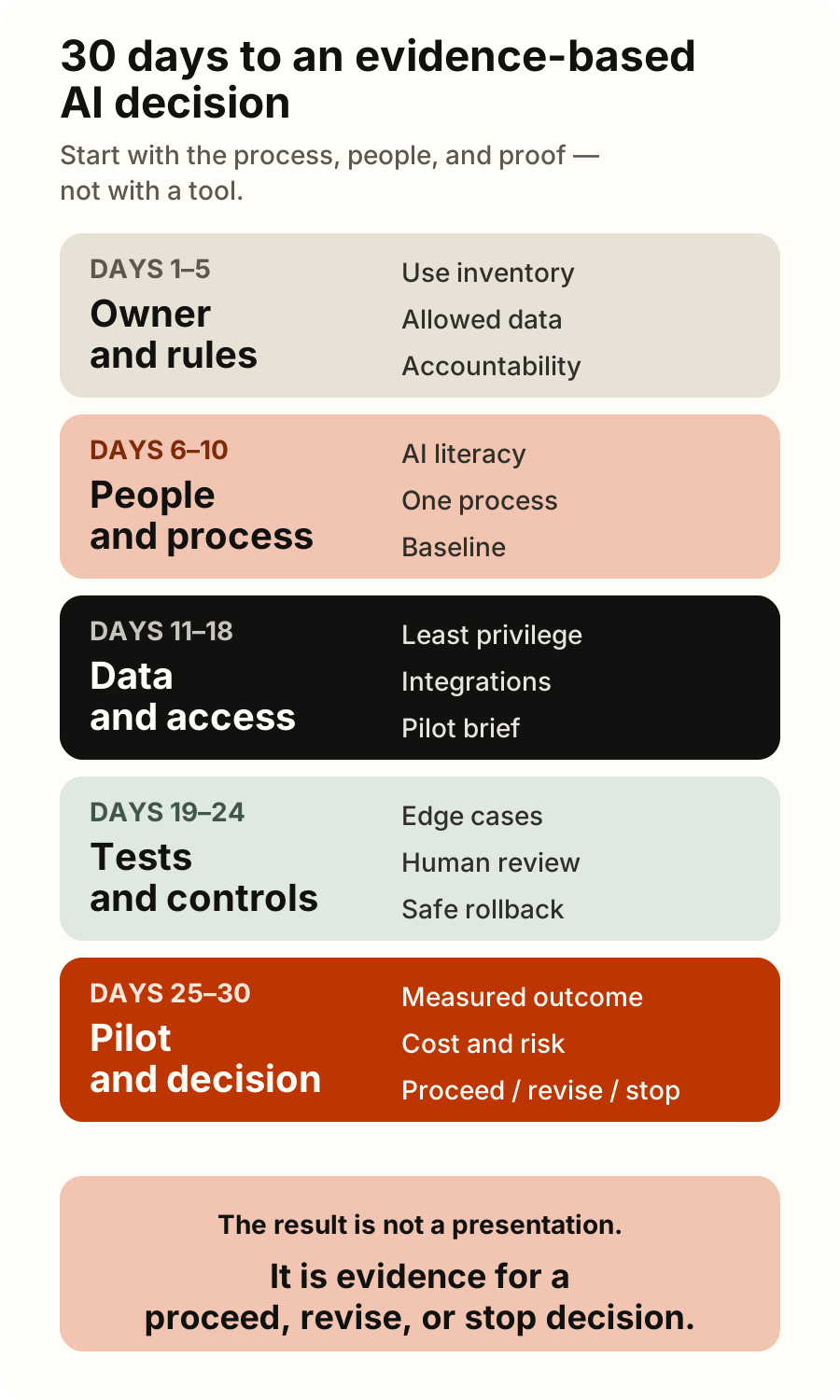
What should exist on day 30
By the end of the first cycle, you should have:
- an inventory of important AI tools and uses already present in the company;
- short rules for approved use, data, output verification, and human approval;
- a pilot team that understands capabilities, limitations, and its responsibilities;
- one bounded process with an owner, a baseline, and an acceptable outcome;
- a map of data, systems, vendors, access, and prohibited actions;
- a representative evaluation set covering normal, edge, and deliberately difficult cases;
- bounded-pilot evidence and a recorded decision to proceed, revise, or stop.
Microsoft’s AI adoption planning framework connects business goals, skills, data, infrastructure, use-case prioritisation, proof of concept, and responsible governance. The NIST AI Risk Management Framework organises risk management through Govern, Map, Measure, and Manage. This 30-day plan turns those principles into one small business cycle; it does not replace the full frameworks.
The first 30 days
| Days | Focus | Concrete output | Decision gate |
|---|---|---|---|
| 1–5 | Ownership, inventory, and rules | Owner, pilot team, use inventory, and short policy | We know who decides, which data is allowed, and what AI must not do |
| 6–10 | AI literacy, process, and baseline | Trained team, selected process, baseline, and risk view | The process is valuable, feasible, measurable, and bounded enough |
| 11–18 | Data, vendor, integrations, and permissions | Minimal architecture, access map, and pilot brief | The solution can work with the minimum necessary data and access |
| 19–24 | Evaluation set, controls, and recovery | Results for normal, edge, and adversarial cases | Quality and controls meet the thresholds agreed in advance |
| 25–30 | Controlled pilot and decision | Evidence about value, cost, risk, and user experience | Proceed, revise, or stop — with a written reason |
The schedule is not a mandatory methodology. If legal, security, or technical review is incomplete, do not move to real data or real-world actions merely because the next week has started.
Days 1–5: owner, inventory, and rules
Name the business process owner and the person authorised to decide scope, access, and whether the pilot stops. Include a domain expert, real users, and security, privacy, legal, employment, or other control roles when the data and potential consequences require them. A single pilot does not need a large “AI council,” but accountability must not sit solely with a vendor or an informal enthusiast.
Inventory the tools and important ways AI is already being used. The purpose is not to monitor every prompt. It is to identify where business data may already leave approved systems, who acts on AI output, and how an error can be reported. The NIST Generative AI Profile recommends system inventories, clear responsibilities, periodic review, and safe decommissioning when a system is no longer appropriate.
A one-page pilot policy can define:
- approved tools, business accounts, and users;
- which public, internal, confidential, and personal data may enter the system;
- which outputs always require human verification;
- which external messages, record changes, payments, deletions, or decisions are prohibited without approval;
- how to report an error, unintended data disclosure, or incident;
- who can stop the pilot and how work returns to the manual process.
AI literacy before broad use
The current Article 4 of the EU AI Act requires providers and deployers of AI systems to take measures that support the development of AI literacy among staff and other people dealing with the operation and use of AI systems on their behalf. Measures should take account of technical knowledge, experience, education and training, the context of use, and the persons or groups on whom the system is used. The consolidated text explicitly says that the obligation does not require a guaranteed specific level of AI literacy for every individual.
Under the Act, a provider develops or has developed an AI system or general-purpose AI model and places it on the market, or puts the system into service, under its own name or trademark. A deployer uses an AI system under its authority, except in a personal non-professional activity. Assess the role for each specific system and use.
The sales team, an invoice approver, and a technical administrator therefore need different learning. The pilot team should understand the real task, allowed data, output verification, escalation, and the consequence of error. The European Commission’s AI literacy Q&A does not prescribe one mandatory course or certificate. As a practical record, you can retain the topics, roles, and dates, but do not claim that a workshop alone proves overall compliance.
For role-based learning, see corporate AI training.
Days 6–10: one process and a baseline
Gather several candidates, but choose one process. Strong candidates occur frequently, have a known input and acceptable output, consume measurable human effort, use accessible data, and produce errors that can be detected and corrected. The first pilot should not automate the company’s highest-consequence decision.
Score each candidate against:
- business value and frequency;
- clarity and verifiability of the outcome;
- availability of representative examples;
- technical feasibility of integrations;
- data sensitivity and consequence of error;
- reversibility of actions and availability of a manual fallback;
- readiness of the process owner and users to participate.
Before building, record the current monthly volume, cycle time, human minutes, waiting, errors, rework, escalations, and cost per accepted outcome. Agree what success looks like, what requires revision, and what stops the pilot immediately. Do not insert a made-up savings percentage; the threshold must fit the baseline and process risk.
Use an AI process automation assessment for structured selection and the AI agent cost and ROI calculator for the financial hypothesis.
Days 11–18: the simplest solution, data, and access
Choose the approach only now. Keep stable rules in deterministic automation. Use a chatbot when conversation is the job. Introduce an AI agent when the system must interpret variable content, choose among approved tools, and adapt several steps. The guide AI Agent vs Chatbot vs Automation helps make that decision before purchasing a platform.
Anthropic recommends starting with the simplest possible solution and adding agentic complexity only when evaluations show that simpler patterns fall short. This guards against an expensive pilot that demonstrates technology without improving a process.
When an agent is genuinely appropriate, the guide How to Build an AI Agent for a Business Process turns the process into inputs, tools, boundaries, and tests. Model and platform selection comes next, and the detailed n8n vs Copilot Studio vs Make vs Zapier comparison ties that decision to hosting, existing systems, governance, and cost.
Document:
- each data source and the purpose for which it is used;
- the vendor, processing location, retention, data use, and exit plan;
- a service identity with the least permissions needed for reading and writing;
- allowed systems, records, domains, tools, steps, and spend;
- actions that wait for human approval and the person authorised to approve them;
- the evidence needed for evaluation, with restricted access and sensible retention.
Connect a CRM, ERP, document system, or another internal source in read-only mode first, through a dedicated service identity with the least required access. The guide to connecting AI agents to internal systems covers permissions, approvals, logging, and safe return to manual work in more detail.
Where practical, begin the PoC with synthetic data or data shown by a contextual assessment to be genuinely anonymous; pseudonymised data remains personal data. If personal data is necessary, identify the purpose and applicable lawful basis, minimise the data, and perform the appropriate security and legal review before processing. A DPIA is not automatically required for every AI pilot, but under the GDPR the controller must carry one out before processing when the type of processing is likely to result in a high risk to people’s rights and freedoms. For confidential or proprietary data, separately check contractual restrictions, trade-secret protections, internal policy, and vendor controls.
Days 19–24: evaluate before real impact
Build an evaluation set from real, appropriately protected examples. Include:
- ordinary successful cases;
- edge, incomplete, and conflicting inputs;
- stale or unavailable sources;
- attempts to extract secrets or move the system outside its scope;
- integration failure, duplicates, and safe retries;
- cases in which the system must stop and hand work to a person.
For each example, record the acceptable outcome, prohibited actions, expected human review, and scoring method. OpenAI’s evaluation best practices recommend task-specific tests, data that reflects the real distribution, edge and adversarial cases, and calibration of automated grading with human judgement.
Rerun the same set after changing the model, instructions, tool, knowledge source, integration, or business rule. A polished demonstration using three hand-picked examples is not an evaluation.
Days 25–30: controlled pilot and written decision
Start in shadow mode or read-only mode. Limit users, volume, duration, and connected systems. Review every output until evidence justifies a lower level of oversight. Keep external messages, official-record changes, payments, deletions, and other hard-to-reverse actions behind explicit human approval. Keep employment decisions and other decisions that may significantly affect people’s rights outside a general first pilot until a specific risk classification and legal assessment are complete; human approval alone is not evidence of compliance.
Track at least four groups of measures:
- business outcome: cycle time, released human effort, backlog, and cost per accepted outcome;
- quality: accepted outcomes, corrections, escalations, and failed cases;
- risk: prohibited actions, unintended data disclosure, security events, and whether the stop mechanism works;
- use: actual adoption, user feedback, review time, and cases where users bypass the system.
On day 30, make one of three decisions:
- Proceed — thresholds are met, risk is acceptable, and the next bounded stage is defined.
- Revise — the hypothesis remains plausible, but scope, data, integration, controls, or training must change before evaluation is repeated.
- Stop — value does not justify cost and risk, quality is inadequate, or a simpler process change solves the problem better.
NIST Manage 1.1 explicitly calls for a determination of whether an AI system achieves its intended purpose and whether development or deployment should proceed. Stopping is not a failed pilot; it is a useful decision made before wider cost and exposure.
Who should participate
A small pilot usually needs five responsibilities, even when one person carries more than one role:
- sponsor: connects the pilot to a business goal and removes organisational barriers;
- process owner: defines the acceptable outcome, exceptions, and measures;
- real user or domain expert: supplies examples and evaluates results;
- implementation owner: controls configuration, integrations, tests, and changes;
- security, privacy, legal, or another control role: participates according to the data, affected people, and possible consequences.
A vendor can support implementation, but it cannot own your company’s business decision, data, or permitted actions.
A one-page pilot brief
Before the first test, write down:
- the problem, current process, and reason AI may help;
- owner, users, scope, and explicitly excluded cases;
- data, systems, vendors, permissions, and retention rules;
- acceptable outcome, baseline, and decision thresholds;
- evaluation set, human review, and prohibited actions;
- duration, volume limit, and spend limit;
- incident owner, stop method, and manual fallback;
- the date and criteria for the proceed, revise, or stop decision.
If these fields cannot be written clearly, the process is not yet bounded enough for a pilot.
What not to do in the first 30 days
- Do not purchase broad licences before defining the process, users, and measures.
- Do not connect an agent through an administrator account “just for testing.”
- Do not use sensitive production data when synthetic or anonymised examples can test the hypothesis.
- Do not measure success through prompt, message, execution, or demo counts.
- Do not expand company-wide before evaluations, ownership, support, and incident procedures exist.
- Do not call a training session proof of overall legal compliance.
- Do not automate a poor process before removing unnecessary steps.
Frequently asked questions
Are 30 days enough to implement AI in a business?
For a suitably bounded use case without unresolved legal, security, or integration barriers, 30 days can be enough for a controlled pilot and an evidence-based decision. It is not a credible promise of full production deployment, compliance, or return on investment in every company.
Do we need an internal IT team?
Not necessarily as a separate team, but you need a named implementation owner and business owner. Bring in IT, security, privacy, or legal roles when the systems, data, and potential consequences require them; an external partner cannot own your business decisions or accountability.
Which process should we choose first?
Choose a frequent process with a verifiable outcome, accessible examples, measurable cost or waiting, and errors that people can detect and correct. The AI process automation assessment helps compare candidates before building.
Which data should never go into an AI tool?
Do not put passwords, secrets, personal, confidential, or proprietary data into an unapproved tool. For every approved tool, verify contractual terms, purpose, retention, processing location, and access controls; identify the applicable lawful basis for personal data, and check contractual restrictions, trade-secret protections, and internal policy for confidential or proprietary data.
When should AI connect to a CRM, ERP, or another internal system?
Only after scope, data, tests, human approvals, and the stop method are clear. Make the first connection read-only, through a dedicated service identity with the least necessary access; see the internal systems integration guide for the detailed pattern.
After day 30
If the pilot passes, the next stage is not automatically “enable it for everyone.” Expand one dimension at a time: more cases, one additional approved action, or one more user group. Rerun evaluations, monitor real outcomes, and update training, access, and policy. If the pilot fails, preserve the findings and stop the spend.
For a concrete first step, submit one process for an AI process automation assessment. The result should be a measurable pilot brief or a reasoned decision not to proceed.
Sources
- EUR-Lex — consolidated EU AI Act, Article 4
- European Commission — AI literacy questions and answers
- NIST — AI Risk Management Framework Core
- NIST — Generative AI Profile, NIST AI 600-1
- Microsoft — Plan for AI adoption
- AWS — Architecting a successful generative AI proof of concept
- OpenAI — Evaluation best practices
- Anthropic — Building effective agents
- GDPR — Regulation (EU) 2016/679
Reviewed on August 31, 2026. This operational guide is not legal advice. Obligations depend on the organisation’s role, the specific system, its data, affected people, and context of use. Check current official sources and applicable sector requirements before a consequential decision.