AI agents
How to Build an AI Agent for a Business Process
Choose the right business process, set clear rules, and build your first AI agent to work safely with human oversight.
Contents
An AI agent is more than a chat interface. Within explicit boundaries, a model chooses the next step, calls tools, and checks results against a business objective. Value comes from improving a process: less manual transcription, faster resolution, or more consistent decision preparation.
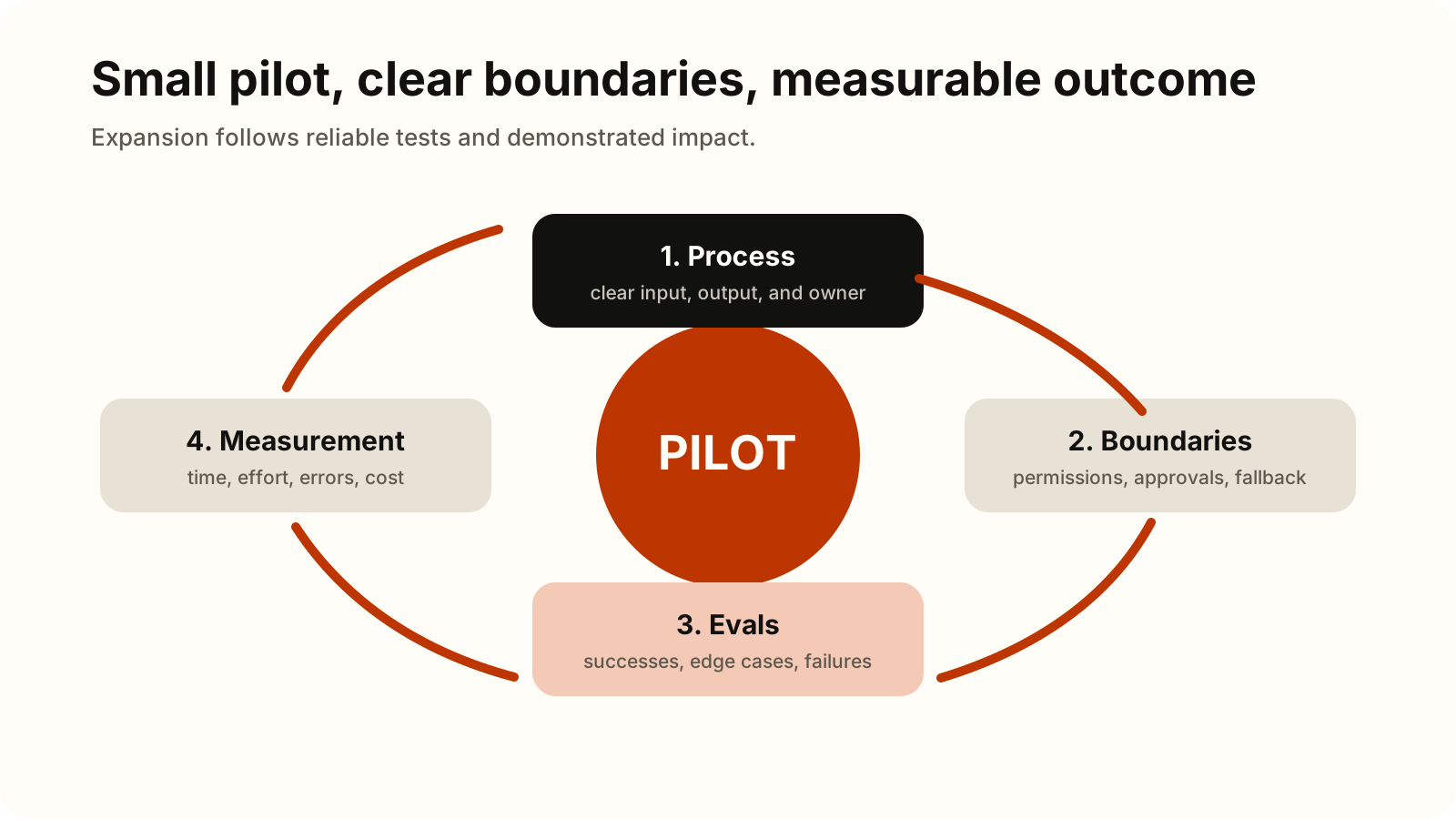
The best first project is a narrow process that can be observed, measured, and stopped. Before building, define what the agent may do, what it must leave to a person, and what evidence will determine whether the pilot works.
Our approach to building AI agents for businesses therefore starts with the business process, authority boundaries, and a measurable pilot.
When an agent is warranted
First ask whether you need an agent. If every step can be described as a rule, form, or conventional integration, a predictable workflow is easier to test and maintain. An agent is useful when the next step depends on the case, the system must choose among tools, or the full path cannot be hard-coded.
Anthropic distinguishes predefined workflows from agents that dynamically direct their work, and recommends adding complexity only when simpler approaches are insufficient. Classifying known request types may need only one model call and an output check. Investigating a complicated case across several systems, then adapting to tool results, may justify an agent.
Choose a process you can prove
Choose one frequent, well-bounded process with a named owner. Its input and expected output should be known, while errors should be limited and recoverable. A good candidate has historical examples for testing and a manual route if the agent stops.
Record how long a case takes, how many human steps it needs, where corrections occur, and how an expert judges quality. Map the normal path, exceptions, required data, systems, and points where an accountable person must decide. Without this baseline, a busy pilot cannot prove improvement.
Build the minimum architecture
A first version usually needs only six parts:
- A trigger or interface accepts the request and the user’s identity.
- A context layer retrieves only the information required for that case.
- The model receives a clear objective, boundaries, and stopping conditions.
- A small toolset reads or changes business systems through their APIs.
- Policy checks validate a call and request human approval before a sensitive action.
- An execution trace records inputs, decisions, tool calls, outcomes, and configuration versions needed for evaluation.
Keep deterministic code responsible for calculations, mandatory rules, and format validation. Let the model handle ambiguity, tool selection, and drafting. OpenAI’s function-calling documentation shows how a model can propose structured arguments; the application must still validate the arguments, authorization, and business rules before execution. Clear names, narrow parameters, and explicit results make each action understandable.
Match permissions to consequences
Do not give an agent a shared administrator account. Apply NIST’s definition of least privilege: each tool receives only the resources and actions needed for its task. Separate read tools from write tools, restrict records and destinations, limit calls and spend, and keep secrets out of model instructions and visible logs.
Checks should sit next to the action, not only at the beginning or end of a conversation. For example, a request to send a message should revalidate its recipient and content immediately before sending. The OpenAI Agents SDK documentation describes input, output, and per-tool guardrails, but the pattern applies regardless of the framework you choose.
Make human approval meaningful
The agent should pause before making a payment, deleting data, sending an external message, changing an official record, or granting access when the action is not easily reversible. Show the proposed action, data source, affected record, reason, and recovery path. A reviewer must be able to approve, reject, or edit it.
OpenAI’s human-in-the-loop guide documents a pattern that pauses a run until a person decides on a sensitive tool call. Do not request approval for every harmless step. Too many prompts make important decisions harder to recognize.
Treat evaluations as the behavior specification
Assemble real, anonymized examples: normal cases, edge cases, malformed inputs, and attempts to push the agent outside its allowed process. Define an acceptable outcome, expected or prohibited tool calls, and when the agent must ask for help. OpenAI’s eval guide uses representative test data and predefined criteria to check behavior.
Evaluate the complete execution, not just the final prose. Check whether the agent used the right source, sent valid arguments, respected approval, and ended in an allowed state. Rerun the suite when the model, instructions, tools, or policies change. In production, sample traces and add newly discovered failures to the evaluation set.
Measure the pilot against the baseline
Agree on metrics and thresholds before launch. Measure correctly completed cases, human corrections, tool errors, cycle time, cost per completed case, escalations, and unauthorized or harmful actions. There is no universal “good” percentage; the threshold depends on the process and risk. Compare the pilot with the manual path on similar cases, measuring quality as well as speed.
Expand authority in stages
Start in a test environment, then use shadow mode without affecting real decisions. Proceed to read-only access, limited writes with approval, and only then broader scope. Every stage needs an incident owner, action log, time limit, and clear switch back to the manual process.
NIST’s Generative AI Profile frames risk work around governing, mapping, measuring, and managing risks across the lifecycle. For a pilot, that means documenting purpose, risks, tests, and rollout decisions is part of the build, not paperwork added at the end.
Do not start with multiple agents
Multiple agents add context handoffs, permissions, latency, cost, and failure points. Begin with one agent or a deterministic workflow. Add specialists only when evaluations show that one system cannot handle clearly separated roles or tool boundaries and the new architecture measurably improves the result.
A convincing demonstration is not the finish line. A successful pilot is a small system whose boundaries can be explained, whose actions can be reconstructed, and whose value can be compared with the business process it replaced or supported.