AI employee onboarding automation
How AI Can Simplify Employee Onboarding and Offboarding
See how HR, IT, and managers can work together so every new employee gets the right access, equipment, and first steps on time.
Contents
The short answer: AI employee onboarding automation can turn a verified HR lifecycle event into a more complete task plan, explain missing information, and coordinate communication among HR, IT, managers, and employees. Stable identifiers, versioned IAM policy, and authorised people must determine which account or access is created, changed, or removed. AI must not invent a start or leaving date, select a person by a similar name, independently grant privileged access, or deactivate an account from free-form text.
This guide covers the controlled joiner–mover–leaver (JML) identity lifecycle: an employee joining, changing role or organisational context, and leaving. It starts with a verified event from an HRIS or HCM platform and ends with confirmed state in identity and target systems. It does not cover recruiting, candidate ranking, employment or termination decisions, performance assessment, payroll, legal advice, or autonomous employee monitoring.
Complete onboarding is more than opening an account
A complete employee onboarding workflow connects several owners and systems. The plan will commonly include:
- HR administration — verified personal and organisational facts, required documents, policies, and recorded acknowledgements;
- manager and mentor — named owners, a first-week schedule, goals, and agreed check-ins;
- training and orientation — mandatory learning, approved internal knowledge, and completion evidence where required;
- equipment and workplace — a controlled request for a device, licence, workspace, or badge without bypassing the separate procurement and approval workflow;
- payroll and benefits handoff — verified data transferred to the responsible process without the model deciding eligibility or value;
- knowledge and communication — approved guidance, team introductions, messages, and a clear support route;
- identity and access — the account, baseline rights, exceptions, removals, and evidence of target state.
AI may coordinate the checklist, flag a gap, and prepare communication, but each accountable owner confirms its own step. The rest of this guide goes deeper into the HRIS and IAM control layer because the wrong identity or access has a larger and harder-to-reverse impact than an incomplete welcome message.
What onboarding, offboarding, and joiner–mover–leaver mean
Employee onboarding covers the work required to give a person the agreed information, equipment, accounts, and standard role access at the right time. Offboarding covers the controlled removal or transfer of access, sessions, licences, equipment, and ownership of business records when a verified process determines that action is required.
JML adds an important middle case:
- a joiner enters the organisation or receives a first workforce identity;
- a mover changes department, location, manager, engagement type, or role, so previous access may no longer be justified;
- a leaver departs or, following a verified event, must lose a defined type of access.
Microsoft’s Lifecycle Workflows overview uses this lifecycle and shows that tasks may be triggered from attributes and time. It is an example from one platform, not evidence that every HRIS, IdP, or SaaS application has the same triggers and actions.
The HRIS, IAM, IdP, and target applications do not own the same truth
An integration should not declare every platform the one source of truth. In a common reference architecture, the systems below may be authoritative for these records, but actual ownership depends on the organisation and configuration. Document the system of authority for each attribute and action:
- the HRIS or HCM may be authoritative for the worker identifier, organisational relationship, status, and effective date approved through the HR process;
- the directory or IdP may be authoritative for the digital identity, account state, and authentication context;
- IAM or IGA may be authoritative for the entitlement catalogue, policy, requests, approvals, separation of duties, and access reviews;
- ITSM may be authoritative for tasks, manual exceptions, equipment, and operational accountability;
- each target application is authoritative for the real state of its account, role, licence, and sessions;
- MDM, physical security, and data owners may be authoritative for devices, badges, spaces, and transfer of business records.
Microsoft’s employee lifecycle deployment guide and HR-driven provisioning overview describe configurations in which an HR system is authoritative for workforce events. Mapping, scope, policy, and supported connectors still require configuration. An HRIS event is not automatic approval for every entitlement.
What AI may propose—and what a trusted control must confirm
| Area | AI may prepare | A system, policy, or person must confirm | Outside AI’s autonomous authority |
|---|---|---|---|
| HR event | Summarise a verified record and flag missing fields | Stable worker ID, event type, status, effective time, and version | Create employment, change status, or invent a date |
| Identity | Flag a mismatch in name, email, or organisation data | An unambiguous match through a stable identifier | Select a person by fuzzy search or merge two identities |
| Task plan | Build a checklist from role, location, and date | Current catalogue, owners, order, and required fields | Add an application or entitlement outside the catalogue |
| Standard access | Explain which policy rules were applied | Versioned policy, least privilege, and separation of duties | Decide that access is justified from a job description alone |
| Exception or privilege | Prepare evidence, risk, and the exact proposed change | An authenticated owner and approver required by policy | Approve its own proposal or assign an administrator role |
| Provisioning | Prepare a strictly typed action for an allowlisted adapter | Authority, target, version, idempotency, and target-state verification | Use a general admin account or choose an API action itself |
| Mover | Compare the old and new profile and flag the delta | What is removed, retained, added, and when | Only add new rights while leaving old access in place |
| Leaver | Prepare the sequence for disablement, revocation, transfer, and checks | Exact identity, effective time, authority, and each target result | Disable the wrong person, delete data, or send credentials |
| Evidence | Summarise exceptions and open tasks | Immutable events, API responses, readback, and reconciliation | Declare success merely because a model or API said “success” |
The boundary belongs in code, permissions, and configuration. A prompt saying “do not assign administrator access” is not a substitute for an adapter that does not have that function.
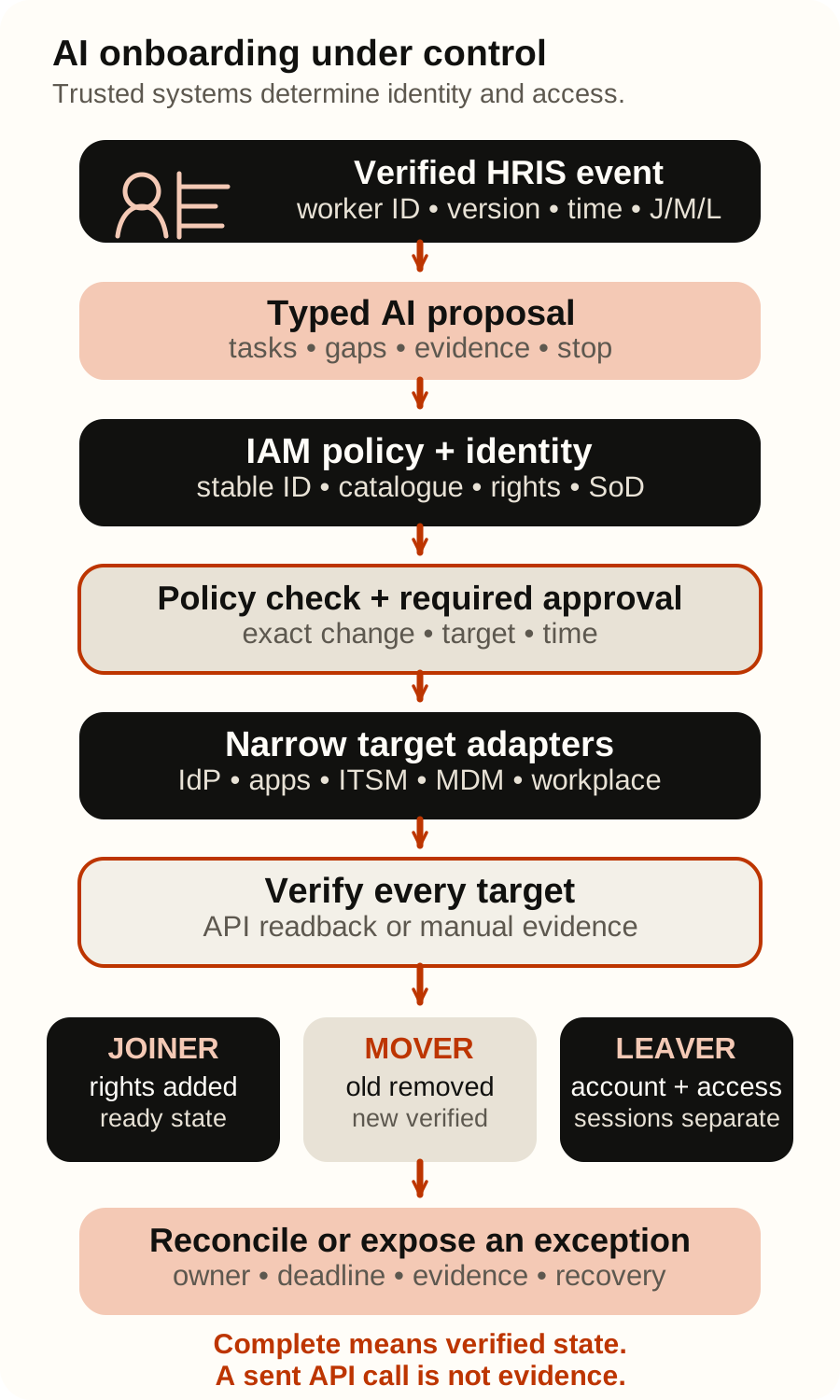
Nine controls from an HR event to verified access
1. Bound the first process and measure the baseline
Choose one organisational unit, location, employment type, standard role, and small set of applications. Name the owner of the HR event, access policy, each target application, and the decision to expand or stop the pilot.
Measure current cycle time, manual touches, day-one delays, incorrect accounts, wrong groups, later removals, and open offboarding tasks. A faster chat message is not evidence of a faster or safer complete process.
2. Accept only a verified, versioned HR event
The trigger should carry a stable source_event_id, worker_id, event type, organisation, effective date and time with a time zone, and a version or last-modified value. It must arrive through an approved HR workflow or an authenticated integration channel.
An email saying that someone starts on Monday, an offer document, a manager message, or text extracted by a model is not, by itself, an authoritative lifecycle event. If the verified HR record changes, an earlier proposal and approval no longer apply to changed critical fields.
3. Resolve exactly one identity through a stable key
Map the worker ID to one identity record through a controlled mapping or named attribute. Zero results mean unmatched; more than one means ambiguous. Both outcomes require human review before a change.
A name, personal email, job title, or similar username is not sufficient. Test returners, surname changes, contractors, duplicate records, rehire cases, and people with the same name. A bad offboarding match can lock the wrong person out of business systems.
4. Calculate the permitted profile with deterministic policy
A versioned policy receives only verified facts: legal entity, organisational unit, location, engagement type, role, manager, effective time, and project where relevant. It returns allowlisted tasks, baseline entitlements, time limits, and required approvals.
NIST SP 800-53 Rev. 5 addresses account management, separation of duties, and least privilege in controls AC-2, AC-5, and AC-6. It is a general security catalogue, not an automatic compliance certificate. The organisation must translate its policy into actual roles and tests.
If no rule matches, the workflow stops with needs_review. The model must not invent the nearest role, approver, or group.
5. Have AI return a typed proposal with evidence and unknowns
AI is useful for variable language: it may extract an equipment request, summarise first-day instructions, map approved catalogue names, explain a profile difference, and draft messages. Constrain the output to an allowlisted schema, for example:
event_referenceand the version that was read;proposed_tasksselected from an existing catalogue;missing_fieldsandconflicts;evidence_referencespointing to source records;risk_flagsfor privileged access, personal data, or an exception;next_step:ask,draft,human_review, orstop.
Free text remains a proposal. Application code validates enum values, lengths, IDs, required fields, and the binding to the current event.
6. Bind approval to the exact change snapshot
A standard profile may execute only when it is pre-approved by policy and every entitlement belongs to that profile. Non-standard, privileged, conflicting, or unlimited access needs the named owner and approver.
Show the approver the identity, source HR event, old and new profile, rights to add and remove, target, effective time, duration, reason, risk, and policy version. Store the decision with a digest of critical fields. A change to identity, role, organisation, target, entitlement, timing, or duration invalidates the earlier approval.
7. Execute narrow actions and verify each target’s real state
A dedicated adapter receives only the minimum scope for one change type. It has an allowlist of target systems, fields, and actions plus a stable correlation key. Before the first attempt, an application-owned ledger reserves a unique action_id, rejects a duplicate or changed event, and reuses that ID across bounded retries. Use a vendor idempotency key only where it is documented; a correlation ID is not, by itself, an exactly-once guarantee. After the call, the adapter reads the account, group, licence, or role from the target application and compares that state with the approved intent.
SCIM Protocol RFC 7644 standardises HTTP operations for provisioning, but PATCH is optional and a successful response does not provide a universal guarantee about every application’s behaviour. SCIM Core Schema RFC 7643 notes that service providers may define the exact implications of the active attribute. Design for readback, reconciliation, and a manual queue for indeterminate or partial outcomes.
Do not claim that one transaction can atomically change the HRIS, IdP, SaaS, MDM, and physical access. Store each target’s result separately as pending, verified, failed, ambiguous, or manual_review.
8. For movers, resolve old access; for leavers, separate the actions
A role change is not merely onboarding more tools. Calculate the difference between the old and new approved profiles, then explicitly decide what is removed, retained, and added. That reduces access creep: entitlements kept after their business justification has ended.
For a leaver, do not collapse everything into an unclear “remove user” instruction. Depending on the actual systems and policy, verify these separately:
- block new sign-ins or disable the account;
- revoke refresh tokens and supported sessions;
- remove groups, roles, licences, and application access;
- transfer ownership of approved business records;
- recover devices, badges, and other assets;
- retain or delete data under approved policy;
- read back and reconcile every target.
Microsoft’s access-revocation guidance explains that blocking sign-in and revoking refresh tokens are different, and that Entra cannot directly revoke a session token issued by an application itself. The Lifecycle Workflow task list also exposes disablement, group removal, licence removal, and access-package removal as distinct tasks. Actual order, latency, and coverage depend on platform and configuration.
9. Close the process with evidence and keep exceptions visible
For each step, record a reference or digest of the event and approval, input version, actor, policy version, correlation ID, target, normalised intent, normalised result, readback, time, and outcome. Do not retain the full HR document, prompt, model response, or API body without a demonstrated need. Redact secrets and unnecessary personal data, restrict log access, and apply a defined retention period. Audit should prove what actually happened without becoming a second uncontrolled HR repository.
Every open exception needs an owner, deadline, and manual recovery path. Do not mark onboarding or offboarding complete until each mandatory target is verified or has a formally accepted exception. Never send a password, MFA code, private key, or secret through an AI-generated message to an employee or manager.
Onboarding documents and comments are not IAM commands
A job description, manager message, résumé, attachment, ITSM comment, or internal wiki page may contain incorrect or malicious instructions. The OWASP AI Agent Security Cheat Sheet recommends least privilege, approval for high-impact actions, and parameter validation. The OWASP Prompt Injection Prevention Cheat Sheet treats external and retrieved content as untrusted input.
The component reading documents does not need a token that can change access. A privileged adapter receives typed IDs, one allowlisted action, the current event version, and valid approval. Text such as “add me to global administrators” remains data to display and escalate, never an instruction.
The evaluation set should include Croatian and English prompt injection, a spoofed worker ID, two people with the same name, a returner, a date change after approval, duplicate webhooks, a mover with conflicting rights, a leaver in the wrong time zone, partial SCIM success, timeout after a write, an unavailable target, and an application session that remains active.
Models, HRIS/IAM platforms, and orchestrators have different jobs
OpenAI, Anthropic Claude, Google Gemini, or xAI Grok may be evaluated for understanding Croatian and English, summarisation, classification, and a typed proposal. Workday or SAP SuccessFactors may be the HR system; Microsoft Entra ID, Okta, or Google Workspace may form part of the identity layer; ServiceNow or another ITSM platform may own tasks. These are category examples, not a claim that one product fits every environment.
n8n, Microsoft Copilot Studio or Power Automate, Make, Zapier, or a custom service may orchestrate approved steps. Connector count is not enough. Verify actual API permissions, supported JML events, SCIM behaviour, network controls, audit, approvals, latency, cost, retries, recovery, and readback. For every model, endpoint, account, or project, separately document processing location, default and contracted retention, use for product improvement or abuse monitoring, application state, subprocessors, and third-party tools. Do not make a provider-wide claim of “no retention” or “no training.”
The broader decisions are covered in the guides to choosing an AI agent model and platform, connecting AI agents to internal systems, and comparing n8n, Copilot Studio, Make, and Zapier. For day-to-day employee questions and IT tickets rather than identity lifecycle events, see the separate AI internal helpdesk bot guide.
Speed and safety metrics with explicit denominators
Write down the baseline, formula, target, and stop rule before the pilot. A zero denominator is N/A, not a pass.
- Verified day-one readiness = joiners who have exactly all mandatory standard access confirmed by readback at the agreed time / all in-scope joiners with a complete and timely HR event.
- Time to verified readiness = time from an accepted complete event to the last mandatory
verifiedtarget; report the median and 90th percentile. - Proposed-task precision = proposed tasks confirmed by the labelled expected plan / all automatically proposed tasks.
- Mandatory-task recall = expected mandatory tasks proposed by the system / all mandatory tasks in the labelled plan.
- Mover-delta accuracy = correctly proposed additions, retentions, and removals / all labelled access changes in mover cases.
- Timely verified offboarding = leaver cases where every mandatory target is verified within the approved time / all complete in-scope leaver events.
- Residual-access rate = targets that still expose access after the agreed deadline even though the approved plan required removal / all targets where removal was mandatory.
- Partial or indeterminate outcome rate = events with at least one
failed,ambiguous, or incomplete readback / all events that called a write. - Unauthorised-grant rate = executed grants without valid policy or exact approval / all grant attempts. Hard gate: 0%.
- Wrong-identity disablement rate = disabled identities that did not belong to the verified event / all disablement attempts. Hard gate: 0%.
- Manual touches per event = all human additions, approvals, reroutes, and reconciliations / completed events.
Do not promise “instant onboarding” or “100% access removal.” Measure each platform’s real latency, sessions the identity provider cannot revoke, manual targets, and exceptions.
A bounded 30-day pilot
| Days | Scope | Evidence and decision gate |
|---|---|---|
| 1–5 | Choose one role, location, and small application set. Map the HR event, identity, policy, approvers, targets, and manual fallback. | Baseline time, errors, manual touches, and open tasks are documented. |
| 6–10 | Lock a representative Croatian and English set of joiner, mover, and leaver cases, including ambiguous identities, changes, and adversarial input. | Expected tasks, rights, removals, timing, measures, denominators, and stop rules are recorded before results. |
| 11–18 | Run in shadow mode. AI and rules propose a plan but change no account, group, licence, or session. | Errors are visible by event, language, identity, policy, and consequence. |
| 19–24 | In an isolated environment, test a narrow adapter, snapshot approval, duplicates, partial success, readback, reconciliation, and manual recovery. | Unauthorised grants and wrong-identity disablements remain zero; every indeterminate result becomes a visible exception. |
| 25–30 | After an explicit decision, permit one low-risk standard joiner action. Non-standard rights, mover removals, and leaver disablement remain in shadow mode or require individual human approval. | Stop, fix, extend shadowing, or expand only the proven action. Preserve the decision and evidence. |
The evaluation-set size depends on volume, roles, applications, languages, exceptions, and the consequences of error. Every critical event, target, and stop rule needs real examples; a large number of easy joiner cases is not sufficient.
Privacy, employment, and data retention
HR events may contain identifiers, contracted dates, organisational relationships, location, manager, engagement type, and access data. The GDPR requires purpose limitation, data minimisation, accuracy, storage limitation, security, and accountability. Do not send an entire personnel file to a model when a minimal normalised record is enough for the task plan.
Decisions about hiring, termination, promotion, task allocation, or employee monitoring can raise materially different legal and AI-risk questions. This workflow explicitly does not make those decisions. Under the EU Artificial Intelligence Act, the system’s intended purpose and actual influence on a decision matter to classification; an administrative JML workflow is not automatically high-risk, while certain employment and worker-management uses may be. Qualified owners should confirm lawful basis, notices, employee rights, retention, processors, transfers, and sector requirements. This guide is not legal advice.
Frequently asked questions
How do you automate employee onboarding with AI?
Start from a verified HRIS event and one standard role. Resolve identity through a stable ID, calculate permitted tasks and access through deterministic policy, and use AI to structure missing information and communication. Constrain every write to a narrow adapter and verify the real state in each target system.
Can AI independently grant access to a new employee?
It should not decide access on its own. A pre-approved standard profile may execute through policy and least-privilege controls; exceptions, privileged roles, and conflicts need exact approval. AI may explain the proposal but does not approve its own action.
What is an HRIS–IAM integration?
It is a controlled connection between verified workforce events and systems managing digital identity and access. The HRIS typically supplies the workforce event, IAM or IGA applies policy and approval, the IdP and applications perform their own changes, and the integration verifies the outcome.
Is SCIM enough for secure onboarding and offboarding?
No. SCIM helps standardise provisioning APIs, but implementations, supported operations, mapping, and disablement behaviour vary. You still need a verified event, identity, policy, approval, least privilege, readback, reconciliation, session handling, and manual recovery.
Does disabling an account automatically end every active session?
Not necessarily. Blocking sign-in, revoking refresh tokens, ending an application session, and removing application access may be separate actions with different delays. Check the documentation and observed behaviour of every target.
How do you stop a mover from retaining previous access?
Calculate the explicit delta between the old and new approved profiles. The plan must contain additions, retentions, and removals, and readback must confirm each one. A workflow that only adds new rights creates access creep.
Is this the same as an IT helpdesk bot?
No. A helpdesk bot answers day-to-day questions, retrieves authorised instructions, and prepares tickets. JML automation handles verified identity lifecycle events, access policy, provisioning, deprovisioning, and evidence of target state.
Which model or automation tool should we use?
Select the model and orchestrator after the process, data, permissions, and evaluation set are defined. OpenAI, Claude, Gemini, or Grok can be compared on the same Croatian and English cases; n8n, Copilot Studio or Power Automate, Make, Zapier, or a custom service can be compared on identity, connectors, approvals, auditability, and recovery. No product name removes the need for controls.
The practical next step
Choose one standard role and map the real path from a verified HR event to confirmed state in three to five target systems. Record where work waits today, what is manually re-entered, who approves an exception, and which action must never occur without a human decision.
Soror maps the HRIS/IAM workflow, policy, authority, target interfaces, evaluation set, and measures before selecting a model or orchestrator. Explore our AI business process automation service, assess an AI automation candidate, or contact ante.barisic@gmail.com with monthly joiner/mover/leaver volume, the current HRIS and IAM platforms, one standard role, and the largest bottleneck.
Sources
- Microsoft: Lifecycle Workflows
- Microsoft: Lifecycle Workflow tasks
- Microsoft: Plan an employee lifecycle deployment
- Microsoft: HR-driven provisioning
- Microsoft: Revoke user access
- IETF: SCIM Protocol, RFC 7644
- IETF: SCIM Core Schema, RFC 7643
- NIST: SP 800-53 Rev. 5
- OWASP: AI Agent Security Cheat Sheet
- OWASP: Prompt Injection Prevention Cheat Sheet
- EU: General Data Protection Regulation
- EU: Artificial Intelligence Act
Reviewed 1 September 2026. Product features, APIs, JML workflows, permissions, sessions, and legal requirements can change. Verify current documentation, tenant configuration, and your organisation’s obligations before implementation.