how much does an AI agent cost
How Much Does an AI Agent Cost? ROI Calculator
Estimate what an AI agent will cost, how much time and money it could save, and how quickly it could pay for itself using your own business data.
Contents
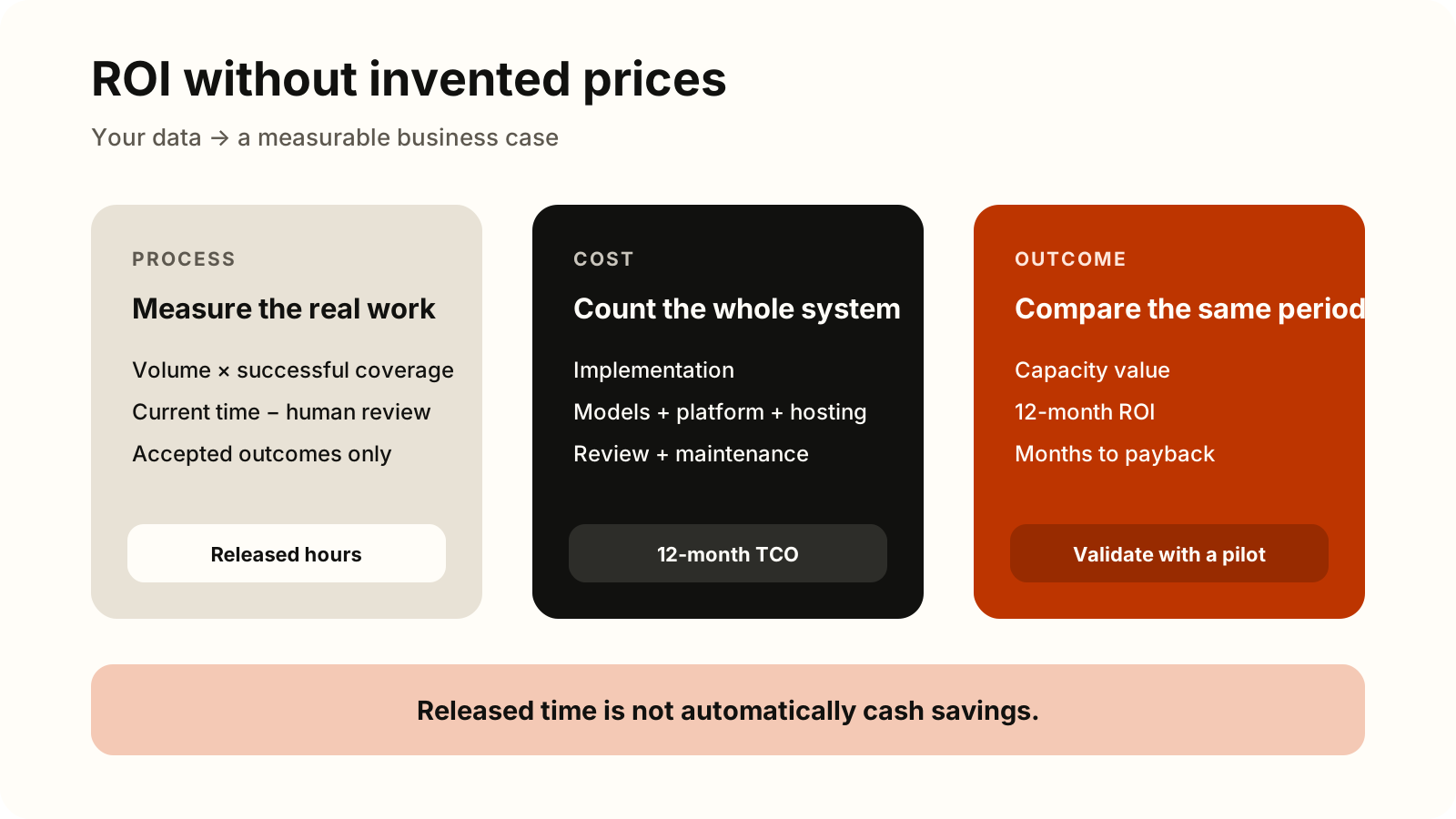
The short answer: an AI agent has no honest universal price without a defined process. Total cost includes one-time implementation and recurring model, platform, infrastructure, evaluation, human-review, and maintenance costs. Return should be measured through successfully completed business cases, net time released, and total cost over the same period — not message or tool-call counts.
The calculator below contains no preset vendor price or claimed “industry average.” Enter your own volume, handling time, successful coverage, and actual quotes. The result is a business-case hypothesis for a pilot, not a savings promise.
AI agent ROI calculator
Enter data for one bounded process. “Successfully handled cases” means the share of total volume that reaches an acceptable completed outcome, not the share the agent merely attempts.
Your values stay in the browser; nothing is sent to soror.
The calculator uses these formulas:
successful cases per month =
  monthly volume × successful coverage

released hours per month =
  successful cases × (current minutes − human review minutes) / 60

monthly capacity value =
  released hours × fully loaded hourly cost

12-month investment =
  one-time implementation + 12 × monthly operating cost

12-month ROI =
  (12 × monthly capacity value − 12-month investment)
  / 12-month investment × 100

implementation payback in months =
  one-time implementation
  / (monthly capacity value − monthly operating cost)
If human review takes longer than the current work, released hours and capacity value will be negative. If monthly net value is zero or negative, there is no payback under those assumptions. If total investment is zero, an ROI percentage is not applicable. Released time is not automatically cash savings: it becomes business value only when capacity is actually redeployed to additional output, faster response, backlog reduction, or a demonstrably avoided cost.
Worked arithmetic, not a market price
The following numbers exist only to verify the calculation. They are not a quote, benchmark, or recommended range:
- 100 cases per month;
- 10 current minutes per case;
- 50% successfully handled by the agent;
- 2 minutes of human review per handled case;
- €30 fully loaded hourly cost;
- €1,000 one-time implementation;
- €100 monthly operating cost.
The result is 50 successful cases, about 6.7 released hours, and €200 of monthly capacity value. After €100 of monthly operations, monthly net value is €100. The 12-month investment is €2,200, capacity value is €2,400, 12-month ROI is about 9.1%, and one-time implementation payback is 10 months.
Change any assumption and the result changes. A real decision must use a measured process and actual quotes, not this example.
What is included in AI agent cost?
Microsoft’s total cost of ownership framework separates initial and recurring AI-solution costs. AWS guidance on estimating ML ROI includes people, training, maintenance, data quality, and the consequences of errors alongside infrastructure. A business case therefore needs more than API consumption.
One-time implementation
- process mapping, baseline measurement, and narrow scope selection;
- data preparation, knowledge sources, and evaluation examples;
- instruction, tool, orchestration, and safe-fallback design;
- CRM, ERP, email, document, or internal API integrations;
- authentication, least privilege, approvals, and action logs;
- evaluations, edge cases, security testing, and production rollout;
- user training and business-process change.
Recurring operating cost
- input, output, and cached tokens plus tool calls;
- workflow or agent-platform licenses;
- hosting, storage, networking, backup, and availability;
- monitoring, traces, evaluations, and human scoring;
- human review, escalations, corrections, and support;
- maintenance of integrations, data, instructions, and security controls;
- incidents and migrations when models or platforms change.
Token price is not AI agent price. A cheap model can be expensive when it retries work, sends excessive context, or produces outcomes that require long review. A more expensive model can cost less per accepted outcome when it completes the task more reliably. Cost per verified successful business outcome is the useful comparison.
Estimating model and platform use
Estimate model consumption on a representative sample of real cases:
monthly model cost =
  input tokens × input price
  + cached tokens × cache price
  + output tokens × output price
  + tool calls
Use current official pricing for OpenAI, Anthropic, the Gemini API, or Amazon Bedrock. Prices, models, caching, batch processing, tools, and regional availability change, so this guide does not copy them into a static table.
Platforms also use different billing units. n8n, Make, Zapier, and Copilot Studio may charge through executions, credits, tasks, or Copilot Credits. Normalize each option to the same process volume and number of accepted outcomes.
For the architecture decision, read how to choose a model and platform for an AI agent.
Getting real calculator inputs
1. Measure the process without AI
For a typical month, record volume, handling time, waiting, errors, rework, escalations, and backlog. Fully loaded hourly cost should use the complete labor-cost figure your company applies in internal business cases, not take-home pay.
2. Pilot on representative cases
Include normal, edge, incomplete, and conflicting cases. Count only outcomes that pass a predefined acceptance check. An agent run, message, or tool call is not a business result.
3. Measure human review and failure
Review time must remain in the calculation. If you subtract human-review minutes from benefit, do not book the same work again as a separate cost. Include failed cases, corrections, and escalations in successful coverage or operating cost — but not twice.
4. Replace estimates with production evidence
AWS recommends ongoing value tracking because cost and outcome change with volume, adoption, maintenance, and model quality. OpenAI agent evaluations can assess the trace across models, tools, guardrails, and handoffs. Rerun evaluation after changing a model, instruction, tool, integration, or business rule.
What the basic calculator deliberately does not monetize
This calculator does not add revenue uplift, fewer errors, faster customer response, tax, discounting, cost of capital, or risk value. Add those benefits and costs to a full business case only when there is a measurable baseline and a clear causal link to the process.
Do not count the same released hours twice as both labor savings and extra revenue. For consequential decisions, build conservative, expected, and optimistic scenarios for successful coverage, review time, operating cost, and adoption.
When an AI agent does not pay
Do not expand a pilot when:
- monthly net value remains zero or negative;
- there is no trustworthy baseline or process owner;
- most cases still require the same amount of human work;
- integrations, permissions, or data create disproportionate cost;
- stable rules can solve the job with simpler automation;
- the consequence of error exceeds the demonstrated value.
Sometimes the best financial outcome is deciding not to build the agent. For the underlying choice, read AI Agent vs Chatbot vs Automation.
Next step
For a concrete estimate, prepare one process, monthly volume, average handling time, a typical and edge case, participating systems, and the actual fully loaded labor cost. Then start with an AI process automation assessment and a small pilot that can confirm or reject the calculator assumptions.
Sources
- Microsoft Learn — TCO criteria for an AI-powered business solution
- Microsoft Learn — ROI analysis for a proposed AI solution
- AWS Well-Architected — Estimate ROI for ML workloads
- AWS — Track business value in production
- OpenAI — Agent evals
- NIST — AI Risk Management Framework Core
Reviewed on August 31, 2026. Model and platform prices, billing units, features, and availability change quickly; check official pricing and contractual terms before making a decision.